
With echoes of one the most controversial debates about film, opera and ballet failing spectacularly to pollute film culture but still lingering in the background, my meeting with internationally acclaimed director Damiano Michieletto proved, in hindsight, to be meaningful and necessary rather than serendipitous. Our exchange offered the possibility to not only get to know his work, creative vision and approach to storytelling, but also reflect on the matter of film that really matters.
Using his first feature film as the essential starting point, our discussion evolved organically around the intertwined nature of cinema and opera. Far from a deterministic reflection of what cinema or opera are or aren’t; how they diverge from each other producing discontinuities, Micheletto identified beautifully and almost instinctively —both through his work and our discussion— cinema’s natural porosity and expansiveness. Cinema’s ability to incorporate seamlessly new elements from other artforms and produce anew; produce a creative whole that introduces new expressions of cinema aesthetics, while remaining grounded in the medium’s inherent narrative structures. In that sense, he achieved something rare for a first-time filmmaker; the potential to not only create through the medium of cinema but work within it and naturally expand its aesthetic expression. In doing so he produced a piece of cinema that doesn’t just present what is often admired and appreciated in a film, but he subtly opened the consideration of what cinema can become, all the inaudible things it can express. What these are, what they aren’t and who gets to decide which artforms and modes of expression they are connected to, is still in to be explored.
To quote the pioneer of cinema Jean-Luc Godard from his important work Histoire(S) Du Cinema (1988) “Cinema is too unknown”, and this comprises, in my opinion, all the beauty, allure and hope about cinema. Equally, to borrow Nan Goldin’s expression, all the bloodshed (2022). Not just about the artform itself but about the people engaging with it, the people who may unconsciously work against it by means of being too identified with a certain tradition, or a rigid, market-oriented approach that occludes their connection with cinema’s true essence. The latter is yet to be fully captured, understood or have its creative potential met. However, each work that attempts to reach that offers not just an important film but also a valuable perspective on what cinema can be. A perspective that embodies the possibility for a Godard-esque new language in cinema; one that encourages spectators to identify with new modes of connecting with cinema that move beyond “seeing”, to “watching” works that go beyond market-oriented or commercialised formulas. Indeed, this is very close to the condition that early avant-garde feminist film theorist Germaine Dulac had first highlighted: “It would be easy to say: the power of money alone halts cinegraphic evolution. But the latter is only a function of the former, which encompasses audience tastes and its habituation to an artistic manifestation which pleases it. I believe, however, that cinegraphic truth will be stronger than us and one way or another will take hold through the revelation of visual meaning” (Dulac, 2019). In this context, the lingering echoes that I referenced earlier, are not only irrelevant to what film and cinema are and can potentially become in relation to opera and ballet, but also worth asking ourselves about the level of distortion they introduce. This is possibly the crux of the cinematic matter that contemporary film theorists, and everyone who loves cinema responsibly, are called to address at the backdrop of a digital-born, celebrity-obsessed strand of market-oriented film culture.
Cut to London, and my meeting with Damiano Michieletto. He spoke to me just before the London premiere of his film Primavera (2025), at Cinema Made in Italy. As if naturally orchestrated, our discussion developed at the backdrop of the first boldly bright rays of sunshine persisting, filling in all interior spaces and breaking, for the first time a wet, cloudy, seemingly endless winter. Primavera (translated in English as Spring) is a film that is personal, yet deeply connected to the 18th Venice, its people, and how they came to connect with Antonio Vivaldi through music.
Set in early 18th century Venice, which is largely considered to be the cultural zenith of La Serenissima (The Republic of Venice), the film depicts a relatively unknown period in the life of Antonio Vivaldi; his life as a priest and a financially challenged musical teacher at the orphanage Ospedale della Pietà. This is there where he meets Cecilia, one of his students who will go on to inspire his work and most famous compositions. A raw talent who discovers music through Vivaldi, Cecilia finds a unique sense of self-determination and empowerment that slowly but surely erodes the artifice of life she had become accustomed to at the enclosure of the orphanage, a barren environment steeped in the patriarchal, misogynistic socio-political norms of the time. Conversely, Vivaldi himself the relatively unknown musical teacher before the genius will be influenced from Cecilia’s journey. The two of them will form the most unlikely alliance in their common struggle to liberate themselves from a life and creativity conditioned by the socio-political circumstances of the era.
The role of music in this film, however, goes beyond that. Music in Primavera moves from an indiscernible yet intrinsic tool in the film’s narrative structure to a refreshing texture that infuses both the film’s story and its aesthetics; intriguingly distinct in that it is not inherently cinematic yet not inherently operatic. Rather, it seems, in my opinion, to be opening the possibility for something new. The visualisation of the inaudible through its affective connection with spectators. The participation of spectators in the experience of a composition that is not yet complete. Rather, spectators are invited to experience the affective impact of something which is not yet fully captured musically but is in the process of becoming expressed and eventually developed into one of the most recognisable compositions. Incorporated seamlessly into the verisimilitude of the cinematic narrative structure, this experience produces a unique texture. A texture that is far more nuanced from any standardised expression of the effects of musical experimentation and the inspiration behind a first composition, defying any medium-restrictive affective flattening. Rather, the subtle nod to the opera here succeeds in creating an aesthetic choice that feels new, even though it might not necessarily be the case.
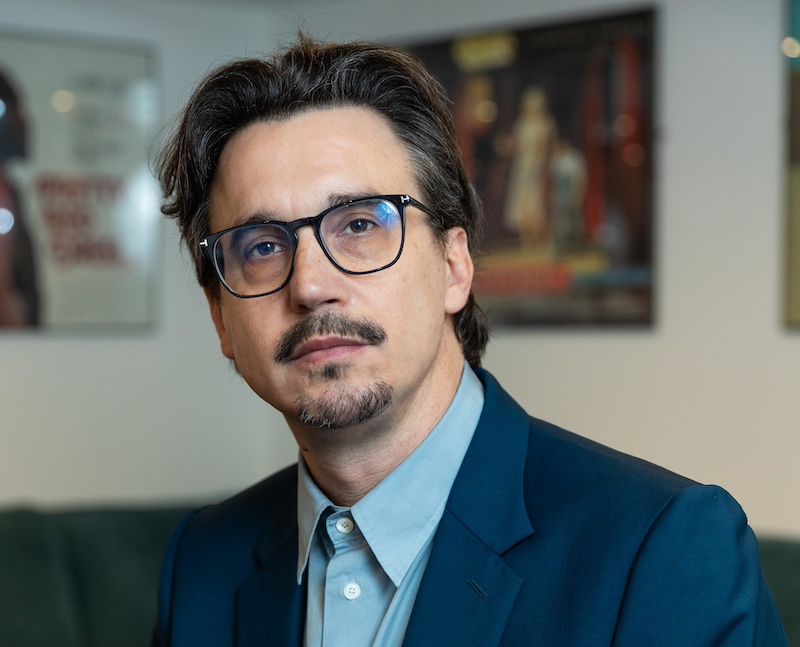
Damiano Michieletto. Photo by Darren Brade.
F.I. Why Primavera? And why now? Obviously, the title is quite fitting as we are at the beginning of Spring, if we look outside!
D.M. Today is a beautiful day!
F. I. What was the inspiration behind creating this work, now?
D.M. Well, I would say it was mainly a personal need to go out of my comfort zone, because I have been working in opera for over 25 years. So, I needed to find a new language also for myself. It was really a personal thing without knowing the result. Rather, it was the need to explore something new. Maybe to find my Primavera as well. To find another language to explore. The reason why I chose the particular title, is because there are many connections with the world now, even though it is period film — it is a film set three centuries ago. It is about a city which is my hometown, it is about music and this is what I have been doing in opera. Telling the story with the music, so I wanted to make a film where music was the main ingredient in the storytelling. And I also liked the fact that I could have an historic figure but at the same time invent it, mix an historic character with a fictional story. I like this combination that can open your imagination and fantasy.
F.I. What is significant about Vivaldi, in this context? Approaching him, his work and his legacy from the perspective of the filmmaker? I was very interested to know how you approached Vivaldi as a historical figure and music genius, in the film. Obviously, he is such a tremendous figure that you are very familiar approaching from an opera perspective, but I was interested to know if your approach was different for cinema.
D.M. I tried to create the portrait of a man and not of an idol. The portrait of a man and not of an artistic with a capital A. rather the portrait of a man who is struggling with his life, with his ambition, with his financial problems. Not the artist that everybody loves but a man who is also a little bit of a coward, a man who is fragile and can be very tender but also very closed. So, I tried to present the psychological figure of a man who was a priest without wanting to be a priest. A complex figure with his shadow. I was not interested in showing him as this stereotype of the genius artist fighting, being crazy.
Also, the music that I put in the film, the music of Vivaldi that I chose was not his most famous work. I chose the music that was useful for me to give this character, basically. Since the story is the encounter of Vivaldi and Cecilia, I was interested in their loneliness and how they find something in common without this ever becoming a love story. From the beginning I said that I don’t want to go into a romance, or to go into this love story where the priest falls in love with a young girl. No, this is about music. It is about what they had in common and the language that they speak together which is the violin, the music. This is the link that I created between the two of them.
F. I. So, why did you feel that this story would be best expressed through cinema and not an opera?
D.M. If you take the novel of Tiziano Scarpa, which is titled Stabat Mater (2008) that I read at the beginning, the novel is closer to an opera structure. Because it is quite synthetic, simple and it is a little bit more, black and white. But my wish was really to transform this story into cinema. It was again a personal desire to create storytelling with actors and to film this story, rather than have it sung on a stage. But definitely the music of Vivaldi and the story of Vivaldi as a teacher is good material for an opera also. Maybe in the future, somebody other than me because I have already made this film, they can take this perspective of Vivaldi being a teacher at an orphanage and develop an opera.
F.I. I asked this question as you have an illustrious international career in opera and many of your works are award-winning productions. Approaching your work from a film theory and film-philosophy perspective, it is indeed very cinematic.
D.M. That’s why the connection with the producer, Indigo Film, arrived. Because the office of Indigo Film in Italy is opposite the front door of the opera theatre in Rome. And they saw some production of mine and, just like you said, they thought: “Oh your production is quite cinematic, cinematographic”. So, that’s how we started. We met and they said if you have a project come to us, we would like to talk about it. And it all happened very naturally.
F.I. I was wondering how you found the process of creating something for cinema. Was it something that you felt familiar with? Was it something that was surprising or unexpected? Because opera and film have similar premises in that you have an ensemble of people working towards something seamless and then the person coordinating this process, the filmmaker or the director essentially needs to disappear. They are there to inspire and give shape to everything, but their impact and contribution is evident in a more subtle way. So, I was wondering if you found the filmmaking experience expected or something or surprising?
D.M. I think both! Because many aspects of dealing with people on a set is similar to dealing with the chaos of an operatic stage where you have technicians, props, people, costumes, and then the chorus and extras. And you need to bring all these things together and create something on stage. So, the approach is similar and then I found that I am very well trained on this. But it was also totally unexpected because your point of view is the camera, so you have to decide where to put the camera and what to shoot and what to frame. Also, the editing is a whole other aspect which doesn’t exist in theatre. But these are precisely the things that I wanted to discover and to try and I wasn’t scared to feel this feeling you get when you don’t know something. This is what I wanted to film. Ok, you don’t know, but it’s fine. It is just important to know where you want to arrive. And then people around you are there to work with you on that.
There is a famous quote of Quentin Tarantino saying, in his own characteristic style “You don’t need to know that that shit of 35mm lead to somebody else. You just know where you want to go”. But it is precisely like that. I took this as guidance. You don’t know all the technical things. People are there because they know this better than you. You have to give the vision. So, the feeling of being new in the system was great. It was like fresh ice water that you react to. And I loved that feeling. Which was totally unexpected and I discovered that I also like to work with that kind of pressure. There were scenes for example that I made the storyboard, let’s say the more complex scene where we have a lot of people around. So, we have the storyboard and only few days. But then I discovered that I didn’t use the storyboard. Because when I was there, I felt another thing and then we changed. So, maybe this is my approach also. It is more instinctive towards the work. It is more trying to feel what the situation gives you and tyring to respond to the truth of what you are facing there and then rather than what you have prepared. So, this kind of confusion was very very good for me.
F.I. Very creative!
D.M. Very creative confusion!
F.I. It sounds like the cinematic language also allowed you to approach the story differently.
D.M. Totally.
F.I. Compared to what you could have done if, let’s say, you were preparing an opera.
D.M. Totally. You work with the details; you have a different approach. You work with actors not with singers and other kinds of animals (laughs). Yes, it is another perspective. You enter in the story through a different door. It is the same story but then it becomes a totally different adventure.
F.I. Going back to the story itself, you chose to show 18th century Venice as you mentioned that you have a very close connection to the city. I was wondering why you chose to focus on the specific period of Vivaldi’s life to show how it impacted Cecilia and potentially the rest of his students, as well as the society of the time in Venice.
D.M. I have to say that the first idea was slightly different because since Vivaldi had been a teacher for over 40 years the first time he arrived at the orphanage he was 24 years old. So, he was also super young. And he was not “Vivaldi”. He was a very young priest. Stop. And then I thought let’s tell the story from a different point of view. A very young girl and a young man, who is also super fragile, super insecure. But this proved to be a bit too difficult because I didn’t know which of Vivaldi’s music, I could potentially use to represent this time. At that time, he had written no music at all, so there wouldn’t have been the possibility to create a similarity between the two of them so as to give the freshness of the character. And I decided to move the story a little bit further down in 1716, a few years before Vivaldi presented Four Seasons to the world.
So, I chose the moment when, yes he had written something. Yes, he had proved to be a good one but still he didn’t write something that allowed him to really affirm himself as a great composer. So, at that point he is someone who is struggling to arrive. And then in his sense I created the connection between him and Cecilia. So, two people that are struggling to find their own voice. Two completely different characters, a man and a woman. A priest and an orphan. But they have some similarities. They are like each other a little bit. And this is what I found interesting to explore further. So, I had the possibility to choose music of Vivaldi but I didn’t want to use the greatest hits of Vivaldi. I wanted to choose something intimate, which could be powerful from a narrative point of View rather than a showing of the music of Vivaldi. And to make clear that this is not a biopic on Vivaldi. It is a period film, but it is the story about his relation to the main character Cecilia who is making this long journey essentially. In order to create this relation, I used music by Vivaldi and also music by a contemporary composer, who wrote music for the film, and I tried to mix that in order to exit from the classical period film. But I tried to have two different languages because we have two different characters and their encounter is the core theme.
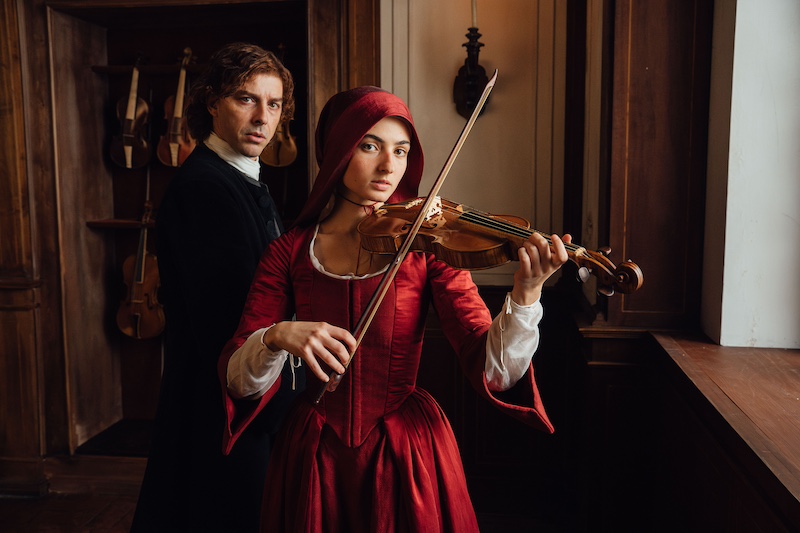
F.I. Yes and I think that what is very interesting in the film also is how this connection or relation is also visualised, as well as the inspiration behind Vivaldi’s compositions and Cecilia’s liberation or self-determination that is expressed through music. There is a particular scene where Cecilia is improvising while playing with children at the lagoon and we are then under the impression that this is the inspiration behind Vivaldi’s famous composition. And I think this is one of the most difficult things to visualise in cinema, because it is not just how the sounds come together but it is also how they evoke a specific emotion which is similar to what people might potentially feel when they listen to the composition alone. So, I was wondering how you approached this scene and also the possibility of having the same connection to the music composition and respecting its legacy but also giving space to the story to develop in an organic and original way.
D.M. Yes, I hope the film has all the things that you said! (laughs). The way that you said it is perfect! I loved it. I would love to arrive to that. It is a very challenging scene and I am also not 100% sure. It is one of the scenes that when I watch it, I go “I could have done this better”. But this is always my process when I look back. I remember that day was a very tricky day, with many things to do and it was super cold. It was a complex day when we shot that scene. But yes, the concept is what you summarised beautifully. It is giving a feeling of something which is growing and you don’t know what it is. And so, I said we can go outside at the lagoon and it is the first time that Cecilia looks at nature, she can hear the sounds, she dreams and she lets herself breathe in this nature of the lagoon. And this imagination evokes sounds and these sounds are a mixture between the violin and the sounds of the nature. And Vivaldi is there and he simply looks at her and this created a sort of bubble of sound for a few seconds which is immediately cut soon after because they go back to the orphanage and their routine. This is also why the other girl says “Why are you so sad, now? There is no point in going out to enjoy life if then you have to come back here and conform to this structure”. So, we have this contrast between what is outside, life outside here, and what is life here. Which is not a cage, it is a privileged place where you can learn music, and you can do a lot of things but still it is not the real life. So, this contrast is also the tension about Vivaldi himself. I am an artist and I have a language and with this language I want to express something that is alive. How can I do that? How can I arrive to touch the audience with my music and do something alive? So, how can you do that? This is the mystery, no?
F.I. Finally, I was very interested to know about the process of working with the actors who were not all trained musicians. So again going back to this sense of evoking a similar feeling, and how we can imagine that the piece would be later on, how it could connect to spectators, how was it to work with people who did not necessarily have a musical training?
D.M. Well, all the girls that were playing were professional musicians. So, they were perfect. Very aware to what it means to play. The singers that we had were professional singers. So Michele Riondino as Vivaldi, Tecla Insola as Cecilia and a few of the main protagonists were not trained in music. They started in the summer before we started shooting and we never used a double for their hands or anything. And we never made any digital corrections, so this is how we shot the film. I had the music teacher close to me during the shooting and every time I asked him if what we see was ok, if it made sense. And with Tecla, who plays Cecilia, 80% of what she played was correct. So, she was very precise, and also I chose music which was easy for her to learn, rather than super-huge virtuoso compositions that made no sense. So, I tried to use music that made sense and she could learn and she learned precisely the movement of the fingers and the bow and that was it. The way that you saw the film is the way that she did it actually.
Interview to Eirini Nikopoulou
Info:
The film Primavera is based on the award-winning novel Stabat Mater (2008) by Tiziano Scarpa. It premiered in London during the Cinema Made in Italy Film Festival at the BFI, and will be available in UK cinemas by Curzon from 24 April 2026.
Written by Ludovica Rampoldi and Damiano Michieletto. Directed by Damiano Michieletto. Cast: Michele Riondino, Tecla Insola, Fabrizia Sacchi, Andrea Penacchi. Cinematographer: Daria D’ Antonio. Music: Fabio Massimo Capogrosso.